

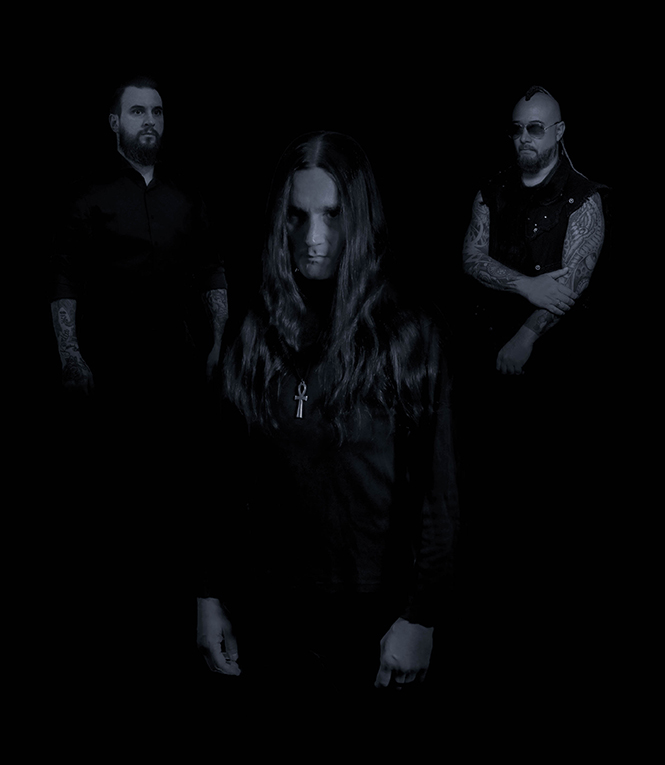
The new Aborym album is coming out soon and I can’t wait to hear it, so I decided to ask Fabban a few questions to find out more!
JULIEN: Hi Fabban, welcome to BLACKZine.com. Let's jump right in with a classic question: How were Aborym born, and why?
FABBAN: Tsunami Edizioni has published a book by Mariano Fontaine, Aborym: Cultura del Chaos, which chronicles the entire history of Aborym from 1992 to today. The book is masterfully written and full of interesting details and anecdotes. Anyway, Aborym formed many years ago in Taranto. There were basically two of us: me on bass and vocals, and Mental Siege was the drummer who, paradoxically, was better at guitar; in fact, he wrote the first songs that ended up on the debut demo. In those years I published a xerox 'zine and received embarrassing quantities of demos, vinyls, seven inches... I was in contact with hundreds of bands from all over the world and somehow I felt the need to put myself out there on a musical level too. For me it was a real escape from the social context in which I lived as well as a sort of vehicle through which to channel a whole series of things that I didn't like about the system, religion and people's way of thinking. Where I grew up, having a band or, in general, an interest or passion for something was a lifeline to avoid being swallowed up by the streets, crime, and drugs. It worked, in part…
J: If you had to explain Aborym to someone who's never heard your music, how would you do it—maybe by quoting a line from a movie, referencing a scene, or naming a film outright?
F: “This is a damn good cup of coffee! I can’t tell you how many cups of coffee I’ve had in my life, and this is one of the best.” A quote from Dale Cooper in Twin Peaks.
J: Your lyrics convey a mix of nihilism, occultism, and social criticism: is it more provocation, personal reflection, or both?
F: I don't think I need to provoke anyone with the lyrics I write. What I write is more like rants or snapshots/timeframes relating to that period and that context. They're concepts and ideas, sometimes confessions or outright attacks on something or someone. I hope there's still someone who reads album lyrics; I put them on the same level as the music, and I think they're a very important channel of communication.
J: "Fire Walk With Us" turned 25 years old. Listening to it today, is there anything you'd change?
F: No. Every Aborym album has its own story and “Fire Walk With Us”, like all of them, is an album that has contributed to the growth of Aborym and of the people… of some of the people behind it.
J: What do you think of AI? What's your relationship with it, and what are your thoughts on AI in the music field?
F: Music must be perceived, created, and captured by those who can perceive it, create it, and capture it on a support. Artificial intelligence is extremely toxic and harmful to music and art in general. It's yet another attempt to legitimize a globalization and massification that will bring no good and will contribute to the definitive flattening of creativity and the entire music industry, already adrift in a sea of shit. AI can be useful in many ways. Not in music. Not for music.
J: How do you experience the relationship with digital platforms that "offer" music? Do you think lyrics and concepts still make sense in an era where users listen to just a few seconds of a random track from an album and then skip?
F: As I said before, for me and Aborym, lyrics are fundamental, as are music, sound, and quality in pre-production, production, and post-production. I grew up in an era before the internet and music existed on vinyl, tapes, and CDs, and I'm genuinely connected to all of this. The internet and the record industry together have contributed to the decline of music by massifying it and making it accessible in a haphazard and senseless way. Money in their pockets and a pain in the ass for musicians and bands. I still buy vinyl and CDs, I use the online hemisphere only to listen to previews, but when it comes to listening, I need a vinyl or CD, with artwork, packaging, and everything else.
J: Which albums have influenced your musical style the most?
F: Bathory's first album from '84 was the first album that changed my life and launched me into the most violent and darkest metal. Sepultura's "Beneath the Remains" from '89, I think, Morbid Angel's "Altars of Madness," Kreator's "Pleasure to Kill," along with Metallica's "Kill 'em All," Maiden's "Somewhere in Time" and Pink Floyd's "The Wall" are some of the albums that shaped my musical development. Nine Inch Nails’ “The Downward Spiral” and “The Fragile,” along with early albums by Skinny Puppy, Einstürzende Neubauten, and Current 93, are some of the ones that really captivated me later on and set me on a path towards experimentation and the fusion of musical genres.
J: What are you listening to these days? Which genres and bands do you listen to the most right now?
F: My listening habits are very biased. I listen to absolutely everything… In the last few weeks, for example, I've listened to "Blessed are the Sick," "The Last Judgement" by Chronical Diarrhoea, an old German crossover-thrash band, "Soul of Shade" by Brisen, a CD with Soviet tracks from the Patriotic War-era Red Army, “Группа Крови” by Kino, and "Seelenfresser" by Tumor…I also listen to a lot of movie and musical soundtracks... a few days ago I listened to the Rock Horror Picture Show vinyl again… I also listened to some new songs by Les Longs Adieux, a band from Rome for which I had the pleasure of working as a producer.
J: If you could collaborate with a director or visual artist on an "Aborym" project (a film, installation, etc.), who would you call, and what kind of work would you want to create?
F: I would have given anything to work with David Lynch. Alessandro Bavari is a truly creative visual artist, and I love his style. I even tried to create the conditions for a collaboration, but we couldn't find the right compromise… Pupi Avati is a great director with whom I would love to collaborate.
J: After these personal questions, let's get back to Aborym: tell us about the new lineup
F: The new Aborym, in essence, today are the old Malfeitor of Unio Mystica Maxima. Atum is the drummer and Munholy on guitars and I deal with everything that is electronic, synthesizers and vocals. In September 2025 I left with my wife to Spain for a short holiday in Barcelona and I thought it was a good idea to call Atum, who lives there. Well, it was a great idea because we had a great evening together, we drank and talked a lot. Probably because of the alcohol we let ourselves go and fantasized about a possible musical project to carry out together. Atum literally made me greedy with his enthusiasm and energy so I took three days to think. Three days later, we reconnected with Munholy, and by the fourth day, we had already laid the foundation for the rebirth of this band. Together. And there's no comparison to the past. I've never had such a powerful connection as I do with them when we make music, and I've essentially rediscovered two great friends, almost 20 years later.
J: Aborym have always had a hybrid identity blending black metal, industrial, and electronics—what should we expect from the new album?
F: Without a doubt, it will be the Aborym's most feral album to date. The most violent ever. It will be a very dark, rude, yet highly technical album. An album that will shock more than a few people out there. We're taking back what's always been ours.
J: Can you tease us some more info about the new album?
F: We're recording it these days between Barcelona in Spain, Helsinki in Finland, and Rome, where it will be mixed and mastered by Andrea Corvo at Synthesis Studio. The album will feature several guests, and the artwork will be quite disturbing and inspired by Wiener Aktionismus, an artistic movement that developed in the first half of the 1960s in Austria, characterized by an insistent use of psychological, sado-masochistic, and self-harming images and themes, inspired by a widespread irreverent, at times profanatory, attitude towards religious symbols, bodily functions, and sexual practices.
J: Unfortunately, time is running out and the interview is coming to an end, so now the floor is yours!
F: Thank you, and I salute everyone who read this interview, and I invite you all to follow Aborym. See you around.


